We don’t grow up in a vacuum.
We grow up in systems (i.e. families, cultures, environments, etc.) and we adapt to them with remarkable creativity. Sometimes those adaptations become strengths. Sometimes they become burdens. And most of the time, we don’t even realise we’re carrying them.
One of the most powerful things therapy can offer is the space to understand these early relational blueprints (what Transactional Analysis (TA) would call the scripts we unconsciously absorb). Not to blame, not to criticise, but to make sense of why we relate the way we do today; why certain patterns feel so familiar, why some emotions feel overwhelming, and why relationships can both nourish us and confuse us at the same time.
Understanding where your relational patterns began is not about living in the past.
It’s about finally seeing the map you’ve been using all along.
Family Systems: Our First Blueprint for Connection, and the Beginning of Our Scripts
From a systemic perspective, a family isn’t just a collection of individuals, but an emotional ecosystem. Every person influences the others, and everyone plays a part in keeping the system balanced, even when the balance is fragile or painful.
Children especially are exquisitely attuned to this. Long before they have language, they are reading tone, energy, tension, rhythms, and emotional availability. They learn:
- how to stay connected,
- how to stay safe,
- and how to remain part of the family.
And they learn those things by adapting.
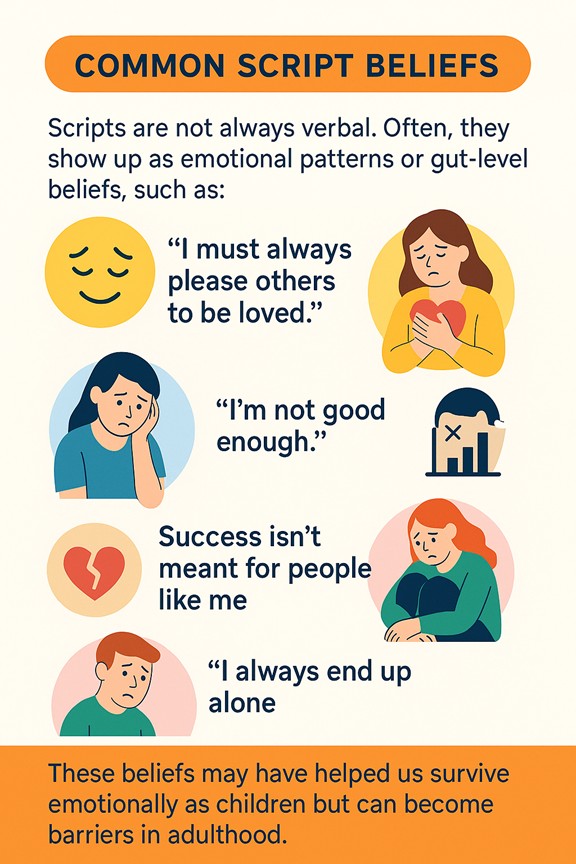
In TA, this is where scripts begin. Not because anyone writes them down, but because children absorb:
- injunctions like “Don’t feel,” “Don’t need,” “Don’t be close”
- drivers such as “Be perfect,” “Be strong,” “Please others”
- and the emotional conclusions drawn in response to the family climate
These adaptations/scripts are not failures or deficits. They are functional responses to the emotional climate of the family at the time. They’re ways of maintaining closeness, security, and belonging (AKA the things every child needs to survive).
By the time we enter adulthood, many of these adaptations have become so familiar that we can’t distinguish them from our personality. They simply feel like “who we are.” But they often began as protective strategies: ways of navigating the emotional weather of our earliest relationships.
The Roles We Learn Without Realising
Most families (even loving, well-intentioned ones) operate with unspoken roles. No one assigns them. No one sits the child down and says, This will be your job.
But children naturally gravitate toward whatever role stabilises the system.
Some common roles include:
- The Responsible One: steady, capable, always anticipating what needs to be handled.
- The Caretaker: attuned to everyone else’s moods, soothing tension before it erupts.
- The Mediator: skilled at calming conflict, smoothing interactions, keeping peace.
- The Strong One: emotionally self-contained, rarely asking for support.
- The Quiet One: staying small, contained, and out of the way so others can stay calm.
- The Performer or Comic Relief: lifting the emotional temperature with humour or charm.
- The Adaptable One: shape-shifting to whatever the family needs in the moment.
None of these roles develop because a child chooses them. They develop because the child senses, intuitively and somatically (physically), that this way of being keeps them connected. And connection is survival.
In TA terms, they’re the lived-out strategies, the script decisions, that answered questions like:
- How do I stay connected here?
- How do I stay safe?
- Who do I need to be for this family to work?
As adults, we often find ourselves slipping back into these roles automatically. Often during times of stress, during conflict, around certain people, or even in moments of intimacy. The nervous system remembers what once kept us safe, and it repeats those patterns long after the original context has passed.
How Scripts Shape Our Adult Relationships
Scripts tend to show up most intensely in close relationships because relationships activate our earliest relational templates.
For example:
- A Be Strong script can make it hard to ask for help.
- A Please Others script may lead to self-sacrifice.
- A Don’t Be Close script can create a push-pull between longing and fear.
These are not conscious choices. They’re automatic responses shaped by early emotional environments: systemic patterns meeting TA’s internalised rules.
Why These Old Patterns Are So Hard to Change
You can have all the insight in the world—you can know a pattern is hurting you or limiting you—and still find it incredibly difficult to shift.
This isn’t because you’re failing. It’s because these patterns were learned early, reinforced often, and tied to your sense of safety and belonging.
- Neurologically, relational learning is encoded through repetition.
- Emotionally, it’s reinforced by the way others respond to you.
- Systemically, it becomes part of how the family functions.
- Mentally, your TA script beliefs still operate automatically in the background.
So even if a role no longer fits who you are now, stepping out of it can feel like stepping out of an identity. It can stir fear, guilt, or anxiety. The body may react long before the mind understands why.
Letting go of an old role can feel like disappointing someone. Even if the “someone” is long gone, or even if the expectation only ever existed in your own internal world.
A Practical Example: The Peacemaker
Picture a child growing up in a home where tension rises quickly. Maybe arguments erupt without warning. Maybe one parent withdraws, another parent becomes loud, or emotions swing unpredictably.
That child learns to read the room with precision; noticing small shifts in tone, facial expression, or silence. They begin to intervene: distracting, soothing, smoothing, comforting, or disappearing to prevent escalation.
It works. The conflict softens. The room settles. And the child’s nervous system makes the association:
“If I keep everyone calm, I stay safe.”
Fast-forward twenty years.
This same person may now:
- avoid conflict at all costs
- minimise their own needs
- apologise even when they’ve done nothing wrong
- over-function in relationships
- feel anxious when someone seems upset
- take responsibility for others’ emotions
Not because they are passive or weak, but because calm once meant survival.
This is how systemic roles and TA scripts intertwine, creating lifelong relational patterns.
Why Therapy Looks Backward Before Moving Forward
As a counsellor in Dorset, when I ask clients about their childhood, their early relationships, or the emotional climate they grew up in, it’s never about assigning blame. It’s about understanding the emotional logic of their present struggles.
Because once you can see the origin of a pattern, something remarkable happens: it stops feeling like a flaw and starts making sense.
You begin to see:
- why you withdraw when conversations get difficult
- why you attach quickly or struggle with vulnerability
- why you feel responsible for everyone else’s feelings
- why boundaries feel threatening or “mean”
- why you feel pressure to be strong, capable, or low-maintenance
These aren’t character defects. They are strategies your younger self adopted to stay connected.
Therapy helps you trace the thread from the past to the present. Not to dwell on what came before, but to give you the clarity and compassion needed to shift what’s happening now.
Relational Hurt Happens in Relationship, and So Does Healing
Most relational wounds don’t come from dramatic events. They come from subtle, repeated moments:
- misattunement
- emotional inconsistency
- role reversal
- invisibility
- pressure to perform
- lack of comfort
- over-responsibility
- unpredictable emotional responses
These experiences shape what we expect from other people. They shape how much of ourselves we feel safe to reveal. And they shape how emotionally close we allow relationships to get.
Because relational wounds are formed in connection, they also need connection to heal. Insight alone isn’t enough. We heal through corrective emotional experiences: moments where someone meets us differently than we were met in the past.
That’s why the therapeutic relationship is powerful. It’s not about the techniques, but about the relationship itself. This is why you will often hear me say in consultations that it’s OK to challenge me if I’ve said something that you disagree with or that might have elicited strong emotions. It’s because I understand an old wound or script may have been activated, and if we can work through that pain and conflict, you might find healing.
The Power of a Safe Therapeutic Relationship
Therapy creates a unique kind of relational space. It’s consistent, attuned, reliable, and grounded. Within that space, you can begin to experience:
- being heard without being judged
- being seen without being overwhelmed
- being supported without being smothered
- being emotionally held without being asked to perform
- having needs without fear of being “too much”
- expressing vulnerability without losing respect or connection
- having a consistent presence in your life
- boundaries that hold rather than restrict
- connection that doesn’t require pleasing, performing, or shrinking
For many people, this is entirely new. And that newness is what begins to gently rewire the nervous system.
Over time, the therapeutic relationship becomes a model—an internalised sense of secure connection. That inner model makes it possible to try new relational behaviours outside therapy: setting a boundary, asking for help, saying no, showing emotion, taking up space.
It’s not just talking. It’s re-learning how to be in relationship in a way that feels spacious, grounded, and true.
Stepping Into New Patterns
Change doesn’t happen quickly or through willpower alone. It happens through:
- awareness
- emotional processing
- nervous system regulation
- relational safety
- and repeated, real-life practice
This is how we loosen the hold of old roles and learn new ways of relating.
You don’t have to stay in the pattern you inherited. You can honour the role that once protected you, and still step into something different now. Something more aligned with who you are, not who you had to be.
Every small shift matters. Every boundary, every moment of honesty, every pause before reacting, they all create space for a new relational story.
Why Your Relationship With Yourself Shapes Every Other Relationship
Across therapeutic approaches (e.g. attachment theory, systemic perspectives, psychodynamic work, etc.) one truth remains consistent:
Your relationship with yourself is the foundation of every relationship you have.
- If you are harsh with yourself, you will assume others are judging you.
- If you ignore your own needs, you will choose people who do the same.
- If you believe you must perform to be loved, you will show up exhausted, overextended, and disconnected from your own truth.
We don’t mean to project our internal world onto others. It simply happens because it’s the only template we’ve ever known.
This is why I will often redirect your relational work back towards yourself. Strengthening your relationship with yourself—learning to listen inwardly, to respond with care, to soothe your own system, to speak to yourself with the same kindness you offer others—quietly transforms your external relationships.
- It softens the way you interpret conflict.
- It steadies you during moments of vulnerability.
- It creates space for boundaries without guilt.
- It allows intimacy without fear of losing yourself.
When you build a healthier internal relationship, your external relationships naturally change. You stop reenacting old patterns, and you begin to relate from a place of groundedness, clarity, and genuine choice.
So, to Sum It All Up
You are not broken for repeating old relational patterns. You are human—shaped by the relationships that came before.
And you are not bound to those patterns forever.
With awareness, support, and a safe relational space to practice new ways of being, you can gently step out of the roles and scripts that once protected you and move toward relationships that feel more authentic, grounded, and free.
This isn’t about becoming a different person. It’s about becoming more you. The version of yourself that didn’t get to fully emerge the first time around.
And that is deeply meaningful, courageous work.
Leave a Reply