If you’ve never been to counselling before, it’s completely understandable to wonder what actually happens in that first session.
There are plenty of articles online that explain what generally happens in therapy, but the truth is that every counsellor works differently. Rather than pretending to speak for everyone, I thought I’d simply tell you what your first session would probably look like if you came to see me.
Because, in my experience, it’s often the unknown that feels most daunting.
Let’s Start With the Obvious…
Talking to a stranger about your deepest thoughts is a pretty weird thing to do.
I don’t mean that in a negative way. I just mean… it’s unusual.
You’re walking into a room with someone you’ve only spoken to once on the phone during the consultation, and somehow you’re expected to start talking about the parts of your life that you’ve probably kept hidden from most people. If that isn’t a strange situation to find yourself in, I don’t know what is.
And I think sometimes counselling can be talked about as though this is completely normal. Personally, I’d rather acknowledge it. Most people arrive feeling at least a little nervous, and many tell me they’re worried they’ll say the wrong thing, not know where to start, or suddenly burst into tears.
The good news is that none of those things are a problem. You don’t have to know where to start, nor do you have to have your story organised. And despite what people often imagine, you certainly don’t have to cry for therapy to be helpful. Some people cry in their first session. Some don’t cry for months. Some never cry at all. None of those reactions tell me whether therapy is “working” (I have other telltale signs for that).
More than anything, my hope is that you leave thinking, “Phew… that actually wasn’t so bad.”
If that’s how you feel after our first meeting, then I think we’ve made a really good start.
What Actually Happens?
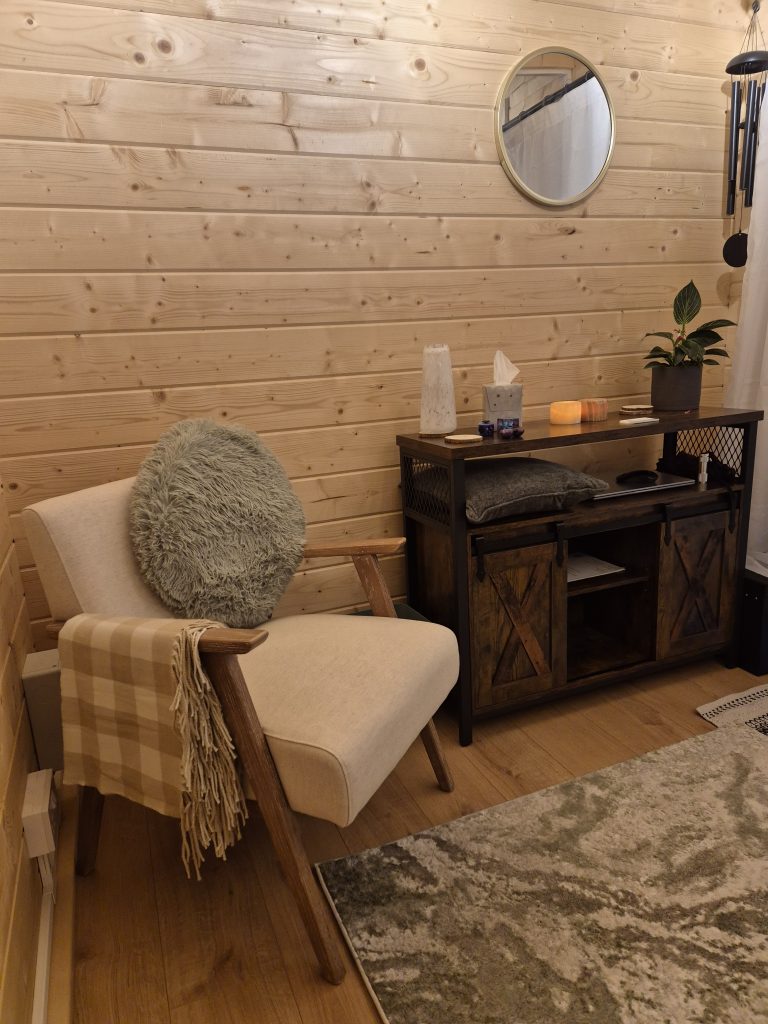
When you arrive, I’ll show you into the cabin and point out which chair is yours.
One thing people often notice is that I take my slippers off before we start. Quite a few clients ask whether they should take their shoes off too. My answer is always the same: if it’ll help you feel more comfortable, absolutely. If not, keep them on. Whatever helps you settle.
I’ll also point out where the water is and let you know that if you’re too hot or too cold, just tell me and we’ll adjust the room. They’re tiny things, but I want the space to feel as comfortable as possible.
You’ll already have received my written contract before we meet, so rather than spending the first part of the session reading through pages of paperwork together, I’ll simply ask whether you have any questions about it. If you don’t, we’ll move on.
I’ve found that most people don’t come to counselling because they want to spend twenty minutes talking about contracts. They usually want to start talking about what’s brought them here, which is obviously fair. If we need to revisit something from the contract later—confidentiality, cancellations or anything else—we’ll do that together when it’s relevant.
Then We’ll Simply Start Talking
One of the first things I’ll usually ask is how you’re feeling about being here.
If you tell me you’re nervous, I probably won’t try to convince you not to be. Instead, I’ll probably say something like, “Yeah… talking to a stranger about your problems can feel pretty weird.”
I find that simply acknowledging what’s already happening often helps people relax.
From there, I’ll ask what would feel most helpful. Would you like to just start talking? Would it help if I asked some questions? Would it be useful if I reminded you what we spoke about during our consultation?
If you’ve told me beforehand that you’re particularly anxious about meeting me, I might even invite you to ask me a few questions first. Sometimes getting to know the person sitting opposite you makes everything else feel a little easier. My aim isn’t to rush into the “therapy.” My aim is to help create a relationship where you feel safe enough to be yourself.
I’m Probably Not What People Expect From a Counsellor
People often imagine therapists as very serious, very neutral people who carefully choose every word they say.
That’s never really been me.
I don’t try to sound like a counsellor. I try to sound like a human being. The person who greets you at the door is the same person you’ll spend the next hour talking to. I don’t leave my personality outside the room and put on a therapist voice, and I don’t “hide” behind a professional identity.
That means I might use humour if it feels appropriate. I might occasionally swear. I’ll ask questions when I think they’ll help, I’ll show you my vulnerability when I experience it, and I’ll often share my thoughts or observations if I think they could move our conversation forwards.
Equally important, I’ll also tell you that you’re more than welcome to disagree with me. Actually, that part is quite essential to me: if I get something wrong, I’d much rather you tell me than politely nod along. Because my job isn’t to be right. My job is to get as close as I can to understanding your world, and sometimes the best way of doing that is for you to tell me I’ve misunderstood something.
What Won’t Happen
I don’t work from a rigid list of assessment questions or a framework that I need to complete before we can begin. If you’ve come in wanting to talk about an argument you had last week, I’m not going to interrupt and ask you about your childhood simply because it’s next on a form.
That doesn’t mean your childhood isn’t important. It often is. But I’ve learnt to trust that whatever feels most alive for you in the moment is usually the best place for us to start. If something from your past becomes relevant, we’ll get there naturally. I trust your process. And I also trust that if something has come into your awareness, there’s probably a good reason for it.
Ultimately, It’s About the Relationship
For me, the first session isn’t about fixing anything. It’s about discovering whether we can create a relationship where you feel safe enough to be yourself.
I hope that, before long, it stops feeling like you’re talking to “a counsellor” and starts feeling like you’re talking to another human being. Someone who’s genuinely curious about your experience, willing to sit with difficult feelings alongside you, and not pretending to have all the answers.
That doesn’t mean we’re friends. The therapeutic relationship has clear professional boundaries, and those boundaries are important. But within those boundaries, I believe therapy works best when two people can meet each other honestly.
I’m aware not every counsellor works like this, and that’s okay too. Finding the right therapist is a little like finding the right pair of shoes—what fits one person won’t necessarily fit another. But if you’ve read this and found yourself thinking, “That actually sounds quite reassuring,” then perhaps we’d be a good fit.
I see most of clients my clients in-person, and support people in Blandford Forum, Shaftesbury, Bournemouth, Poole, Bere Regis, Wimborne, and the other surrounding villages. I also work online for those who are not in a position to make the trip or who prefer to work in a more flexible way.
Click here to enquire.
Leave a Reply